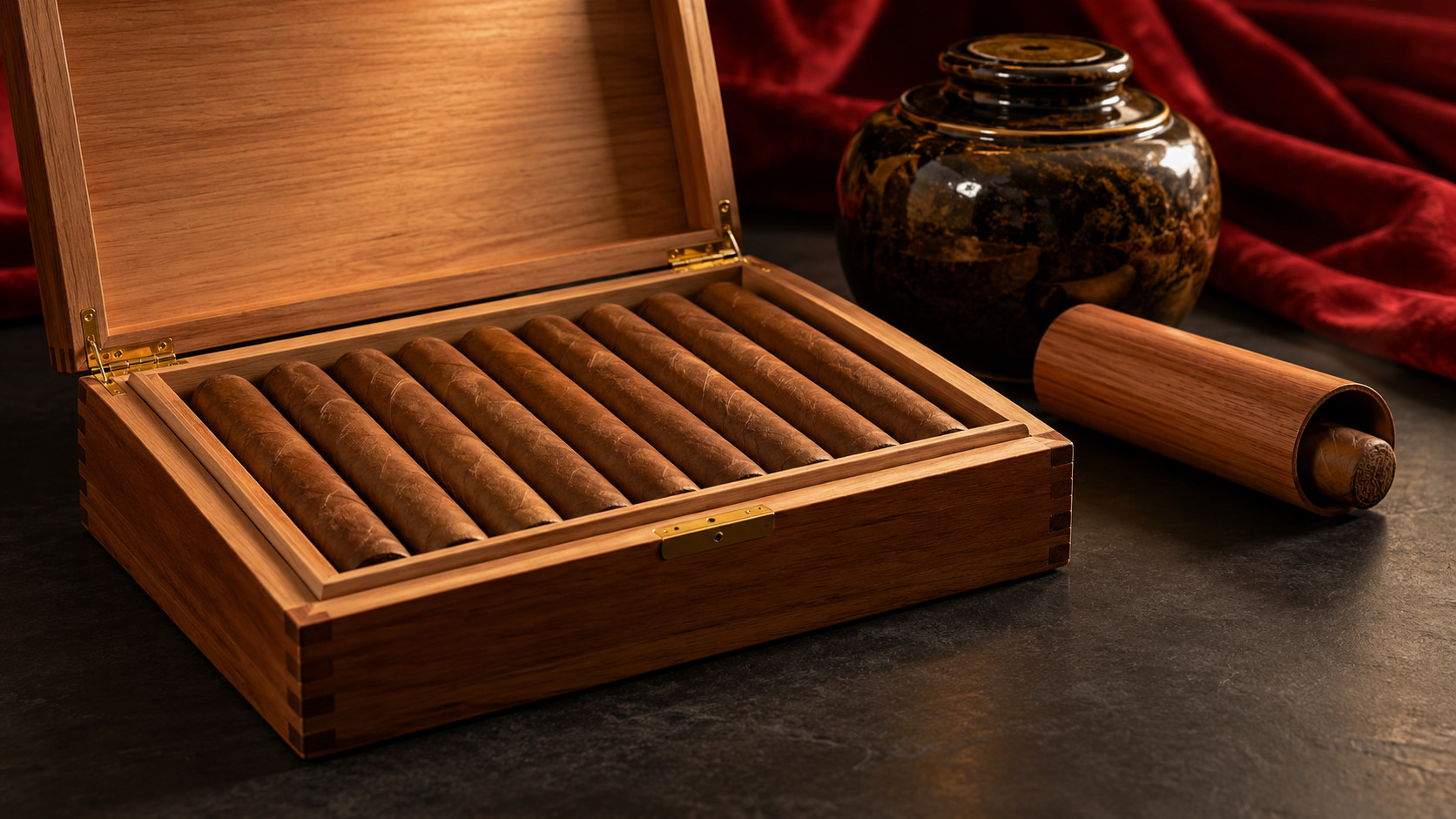

In August 2026, the United Kingdom’s Department of Health and Social Care opened a public consultation on extending standardized packaging rules to cigars. If it becomes law, every cigar box sold in Britain would arrive in the same matte brown, in the same specified Pantone shade, with the brand name permitted three times in 14 point type or smaller and nothing else. No artwork, no color, no crest. The proposal has focused an unusual amount of attention on a subject the trade normally treats as settled, which makes this a good moment to ask what cigar packaging has actually been doing for the last two hundred years, and what would be lost if it stopped.
Quick Answer: Cigar packaging does four jobs at once: it buffers humidity, it protects fragile wrappers in transit, it identifies the maker, and it signals what kind of product is inside. Spanish cedar became the default box material because it moderates moisture swings, carries a complementary aroma and discourages tobacco beetles. Formats range from plain cabinet boxes holding loose bundles, through the familiar dress box, to ceramic and porcelain jars and single-cigar tubes, each trading protection against cost and presentation. Jars have returned as a limited-release format because they seal well and read as an object worth keeping. Regulation is now the live issue: Canada and Australia already require plain packaging, and the U.K. is consulting on the same for cigars, with retailers warning it would sharply reduce how many lines they carry.
Notice that only two of those four are about the tobacco. That split is the reason the subject gets argued about at all. A container that did nothing but keep leaf at a stable moisture level could be a sealed plastic tub, and it would work. Everything beyond that point is doing a different kind of work, which is why a regulator looking at a cigar box sees decoration where a maker sees the only durable way to say who they are.
The first two jobs are also the reason cigar packaging is heavier and more elaborate than the product would seem to require. A wrapper leaf is measured in fractions of a millimeter and splits if a cigar rolls against a hard edge in a delivery van. The box is doing structural work on a fragile object across thousands of miles, and it has to do that work while allowing the contents to breathe.
Despite the name, the wood most often used is not a true cedar and does not come from Spain. It is a tropical hardwood related to mahogany, and the label is a historical accident that stuck because the Spanish colonial trade is where the cigar business first standardized on it. The properties are what matter, and the moisture behavior is the one that decides the question. Wood at equilibrium with the air around it acts as a reservoir, giving moisture back when the surrounding air dries and taking it up when the air is damp, which slows the rate at which the cigars themselves experience change.
That buffering is a genuine benefit and a limited one, a distinction covered in more detail in our guide to how to store cigars. A box slows change. It does not create a stable environment on its own, and a box left on a shelf in a dry room will eventually reach the same state as the room. The wood buys time, not permanence.
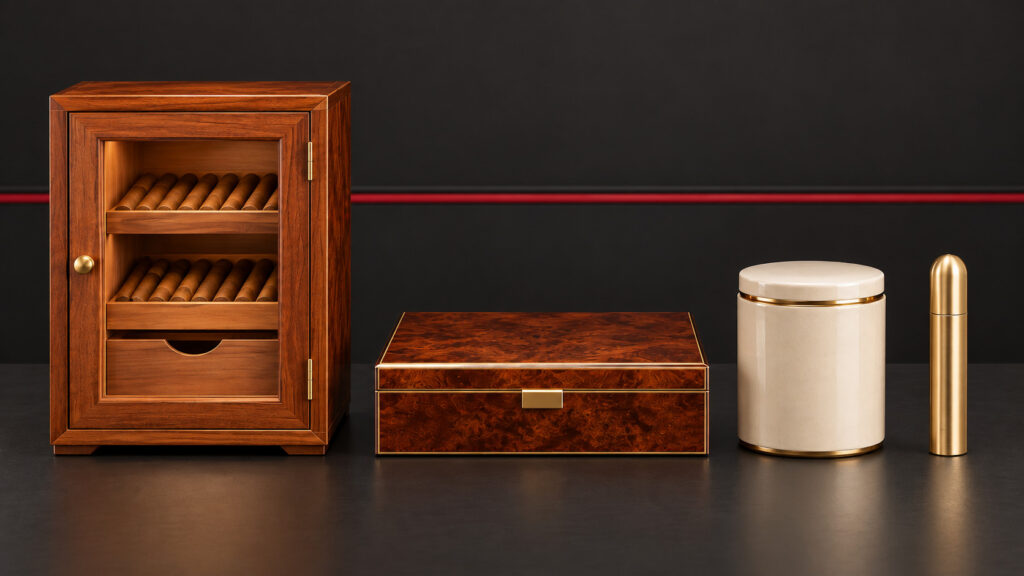
The formats below cover nearly everything on a retail shelf. Each represents a different answer to the same question about how much protection, presentation and cost a maker wants to build in.
| Format | Construction | Humidity behavior | Typical use | Trade off |
|---|---|---|---|---|
| Cabinet box | Plain cedar box, cigars held loose or in bundles tied with ribbon | Strong buffering, cigars in direct contact with wood | Larger counts, traditional presentation | Minimal branding surface, less protection per cigar |
| Dress box | Cedar or cedar lined, finished exterior, cigars seated in trays | Good buffering with individual seating | The standard retail format | Higher cost, more material per cigar |
| Ceramic or porcelain jar | Fired vessel with a gasketed or ground lid | Very low air exchange when properly sealed | Limited releases and gift presentation | Expensive, heavy, no cedar contact unless lined |
| Tube | Aluminum, wood or glass sleeve per cigar | Slows exchange for a single cigar, cedar lined versions buffer | Travel and single sales | Cost per cigar is high, aging behavior differs from a box |
| Cellophane sleeve | Thin film over the individual cigar, usually inside a box | Semi permeable, slows exchange without sealing | Protection in transit and at retail | Widely debated effect on long term aging |
| Bundle | Cigars wrapped together in film, no rigid outer container | Little buffering of its own | Value tiers and factory overruns | Least protection, lowest cost |
Read down the trade off column and a pattern emerges. Every format that improves protection or presentation adds weight, cost or both, and those costs land on a product whose contents may only be worth a few dollars each. That is the pressure every packaging decision in the category is responding to.
The commercial logic is straightforward once you look at what a jar is being asked to do. A fired vessel with a proper lid exchanges very little air, so it holds a stable interior over long periods without any active management. It is also, unlike a wooden box, an object a buyer is unlikely to throw away, which means the packaging keeps working as a reminder long after the contents are gone. For a release built on scarce material and capped at a few hundred units, that combination justifies a cost that would be absurd on a regular line.
Recent examples reported in the trade press follow the pattern closely. halfwheel’s coverage of the Lampert Limitada 2026 notes that the previous year’s release is returning in ceramic jars alongside a new vitola, and other 2026 limited releases have shipped in porcelain jars capped in the hundreds. In every case the jar arrives attached to a limited edition, never to the everyday product.
Direct answer: Cigar labels are one of the most heavily lithographed commercial art forms of the nineteenth century. Gold leaf, deep embossing and multi-stone color printing were applied to boxes at a level of expense that most consumer goods of the period never received.
The reason so much money went into it says something about the market conditions of the time. Cigars were sold in shops where dozens of makers competed on a counter and most buyers could not distinguish the products by any other means. The label was the entire argument. That competitive pressure produced an archive of commercial illustration that museums now collect, and it established a visual grammar that the category still runs on: a crest, a script name, a color that belongs to one house.
What survives from that period is not just imagery but a convention about what a band communicates. It tells you the maker, and by extension it tells you whom to hold responsible if the cigar is poor. Remove it and you remove the accountability along with the ornament, which is the substantive objection to standardization rather than the aesthetic one.
Trade reaction has centered less on how the boxes would look than on what importers would have to do to comply. Cigars arriving from producing countries would need to be reboxed on entry, and the cost of that operation falls on the same margin that currently pays for carrying a wide range of slow moving lines. A commercial manager at one of London’s oldest cigar retailers, quoted by Cigar Aficionado, described the proposal as an existential threat to the U.K. handmade market and estimated the reduction in lines carried at anywhere from 50 to 90 percent.
Whether that estimate proves accurate, the mechanism behind it is easy to follow. A specialist tobacconist stocks a long tail of boxes that each sell slowly, justified by the fact that having them is what makes the shop a specialist. Add a fixed reboxing cost to every one of those slow sellers and the long tail stops paying for itself. The catalogue contracts toward whatever sells fastest, which is the opposite of what a specialist shop exists to offer. This is the part of the proposal that concerns the trade most: the effect on selection, arriving indirectly, through cost.
Those markets are the reason the U.K. debate is being conducted with specifics rather than speculation. Anyone can look at what a shelf becomes when every product on it is the same color and the only variable is the name in small type. The visual result is well documented. The commercial result, in terms of how many lines survive in those markets and at what price, is the evidence both sides of the current consultation are arguing over.
It is worth being precise about scope, since it is easy to overstate. The U.K. proposal sits inside a broader package of tobacco control measures, and premium cigars are exempt from several of the other restrictions under consideration, including some covering retail display. Packaging is the piece where cigars are not carved out. The consultation is also genuinely open, which is why trade bodies have been directing attention to it rather than treating the outcome as settled.
The confusion here is common and understandable, because the box genuinely helps and the help is invisible. What it provides is inertia. Open a humidor twice a day and the boxed cigars inside experience a much gentler version of each swing than loose cigars would. Over weeks that is a real advantage in consistency. Over months in an unmanaged room it is no advantage at all, because inertia only delays an outcome that the surrounding conditions determine.
The practical implication is simply that the box and the humidor are doing different jobs and neither replaces the other. Keep the cigars in their box inside a properly maintained space and both effects compound. That is the whole of it, and anything more elaborate is usually someone selling something.
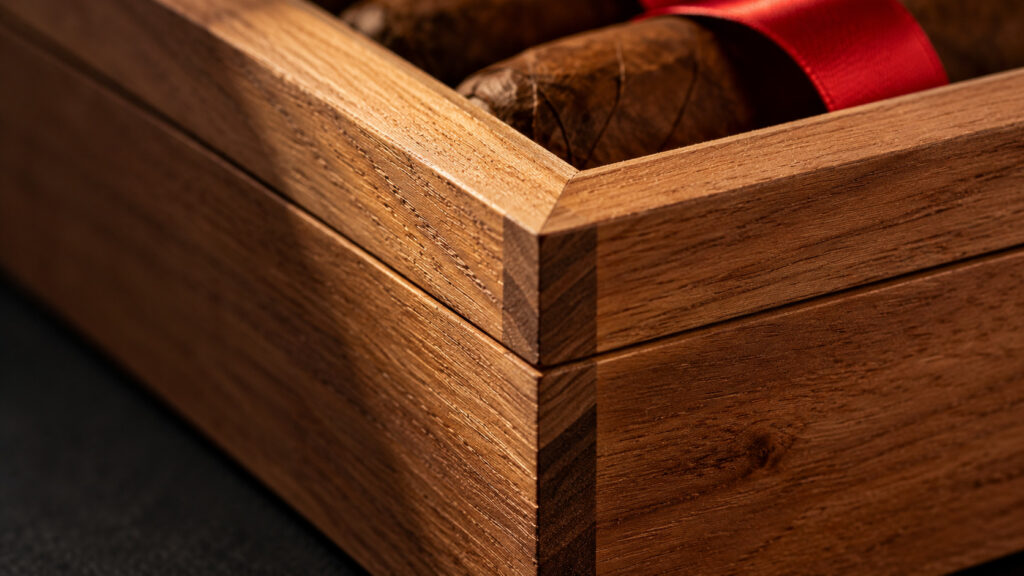
Corners are the most honest part of any box. A mitred joint that closes flush required someone to cut accurately and clamp properly, and a gap at the corner means that step was rushed. The lid tells a similar story: it should sit level and close without a fight, because a lid that binds or sits proud was fitted to a carcass that was not quite square.
Inside, the timber should be visible and should smell of itself rather than of finish or glue. A box that has been lacquered internally has traded its moisture buffering for appearance. And the printing, if there is any, should be crisp at its finest details, since fine detail is exactly where cheap reproduction fails first. None of this tells you how the cigars will smoke. It tells you what standard the operation holds itself to when nobody is checking, which is a reasonable thing to know before you spend money.
Everything above comes down to a single question a maker has to answer: how much does the container matter when the contents are the point? Our answer is that the container is the last piece of the craft, not a wrapper around it.
The Super Premium Collection is hand packed in a handcrafted cedar box, which means the joinery, the lid fit and the interior timber discussed in the previous section are decisions we make rather than specifications we order. Founder and master roller Raul Triana learned the craft in Cabaiguan, Cuba, and brings more than 35 years of experience to the bench in Boca Raton, Florida, where he rolls by hand. The box is finished by people who know what is going into it.
If you would rather see the work than read about it, a live rolling event across Miami, Fort Lauderdale, West Palm Beach, Orlando or the Florida Keys puts the whole process in front of your guests, from leaf to finished cigar. And if the etiquette side of the hobby is what you are curious about next, our piece on cigar lounge etiquette covers the unwritten rules. Every order from the RTS Cigars shop ships free.
For adults 21+ only. RTS Cigars products are intended for adults of legal purchasing age.
The timber absorbs and releases moisture slowly, which flattens short humidity swings inside the box. It also carries an aroma the trade regards as complementary to tobacco and is unattractive to the beetles that damage stored leaf. Despite the name it is not a true cedar and does not come from Spain, but is a tropical hardwood related to mahogany.
A cabinet box is plain cedar holding cigars loose or in ribbon tied bundles, so the cigars sit in direct contact with the wood. A dress box has a finished exterior and seats the cigars in trays, which gives more protection per cigar and more surface for branding. The dress box is the standard retail format.
Yes, inside a properly maintained humidor. The box slows the rate at which its contents respond to the surrounding air, which improves consistency, but it does not hold a target humidity by itself. Box and humidor do different jobs and neither replaces the other.
A fired vessel with a proper lid exchanges very little air, so it holds a stable interior over long periods without management, and it is an object buyers tend to keep. Those qualities justify the cost on small limited releases. Jars are rarely used for regular production because they are expensive and heavy.
It means standardized containers with no branding: a specified drab color, the brand name in small type a limited number of times, no logos or images, and prominent health warnings. Canada and Australia already require it. The United Kingdom opened a public consultation in August 2026 on extending the same rules to cigars, running until October 2, 2026.
The stated concern is commercial rather than aesthetic. Importers would have to rebox product on arrival, and that fixed cost falls hardest on slow selling lines. Retailers argue the result would be a sharply narrower catalogue, with one London specialist estimating a reduction in lines carried of 50 to 90 percent.
Check the corners for joints that close flush, the lid for a level fit that closes without binding, and the interior for visible timber that smells of wood rather than finish or glue. On printed boxes, look at the finest details, since cheap reproduction fails there first. None of this predicts how the cigars smoke, but it shows the standard the maker holds.