
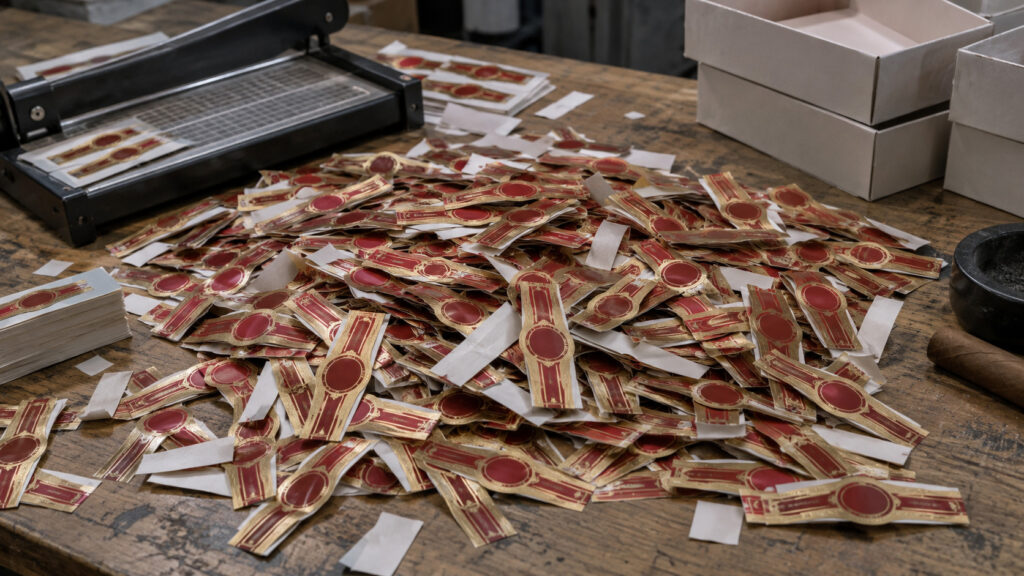
In July 2026 the Spanish Guardia Civil walked into an ordinary apartment in Mislata, on the edge of Valencia, and found a factory. Not a rolling gallery, because nothing there was being made from tobacco. It was a finishing operation: tens of thousands of cigars waiting to be dressed, and more than six hundred thousand printed bands waiting to dress them. Counterfeit cigars almost never begin with a counterfeiter growing anything. They begin with somebody buying cheap product in bulk and buying the illusion separately, then putting the two together. Once you understand that division of labor, most of the advice about spotting fakes stops sounding like folklore and starts making sense.
Quick Answer: Counterfeit cigars are cheap or unbranded cigars fitted with copied bands, boxes, seals and codes so they can be sold as a famous marque. The economics are simple: the fraud lives in the packaging, which costs pennies to print, while the tobacco inside is whatever the operation could buy cheaply. Fakes concentrate around Cuban brands and around a handful of high demand non Cuban names, and they surface most often in tourist areas, street offers, social media sellers and marketplace listings priced well under retail. The reliable defenses are structural rather than forensic: buy from authorized retailers or direct from the maker, distrust discounts that are too deep, and treat any unverifiable seller as a fake until proven otherwise. Band inspection helps, but it is the last line of defense, not the first.
The reason the problem clusters where it does is worth sitting with. Counterfeiting follows two things: a brand famous enough that people who know nothing about the category still recognize the name, and a supply situation tight enough that a shortage feels normal. Cuban marques satisfy both conditions perfectly. They are the names a person who has never smoked a cigar can still recite, and genuine allocation has been constrained for years, so a stranger offering a box at half price is not obviously impossible to a buyer who has been told repeatedly that these cigars are hard to get.
There is a second, quieter market in copies of popular non Cuban brands, which surfaces mostly through online marketplaces and social media sellers rather than through street trade. It gets less attention because the individual dollar amounts are smaller. It reaches more buyers.
Look at the ratio between those two numbers, because it is the whole business model in one line. Roughly thirty four thousand cigars, and roughly six hundred thirty seven thousand bands. The operation held nearly twenty printed bands for every cigar on hand, which tells you the bands were not scarce, not expensive and not the bottleneck. They were stock. The plan was clearly to keep sourcing product and keep dressing it, brand by brand, as demand dictated.
The charges reported against those arrested cover smuggling, crimes against industrial property, membership in a criminal organization, and an offence against workers’ rights. That last one is the item most smokers skip past, and it is the one that says most about the conditions inside these operations.
Direct answer: The tobacco and the identity are sourced separately. Cheap machine made or low grade hand made cigars are bought in bulk and unbranded, then bands, boxes, seals, warranty stamps and box codes are printed to match a target marque, and the two are married in a room with no connection to any farm or factory.
Each layer of the disguise has its own supply chain. Bands are the easiest, since modern printing handles gold foil, embossing and fine linework at a quality that would have been impossible for a small operation twenty years ago. Boxes are harder, because a genuine cabinet or dress box involves specific timber, joinery, hinges and interior finish, all of which cost real money to imitate. Seals and stamps sit in between: the printing is achievable, but the placement and alignment demand a care that a room working at volume rarely applies.
The consequence is a predictable hierarchy of quality in fakes. The band usually looks convincing. The box usually looks close. The assembly, meaning how everything sits together, is usually where the operation gives itself away, because that step is manual, repeated thousands of times, and performed by people being paid to be fast rather than exact.
Inside, the cigars themselves range from mediocre to genuinely unpleasant. Because the filler is whatever was cheap, buyers commonly report bunches that are wildly inconsistent from stick to stick within one box, along with construction problems, uneven burn and, in poorly stored product, mold or beetle damage. There is no quality control in a counterfeit operation, because quality is not what is being sold.
No single detail proves a cigar is fake, and no counterfeiter fails every test. The table below collects the differences that experienced buyers and trade press guides return to most often, which are useful as a pattern rather than as a checklist.
| What to examine | Typically seen on authentic product | Common on counterfeits |
|---|---|---|
| Price | At or near authorized retail, discounts modest and explainable | Far below market, often half or less, with urgency attached |
| Seller | Authorized retailer, established shop, or the maker directly | Street offer, hotel approach, social media account, anonymous marketplace listing |
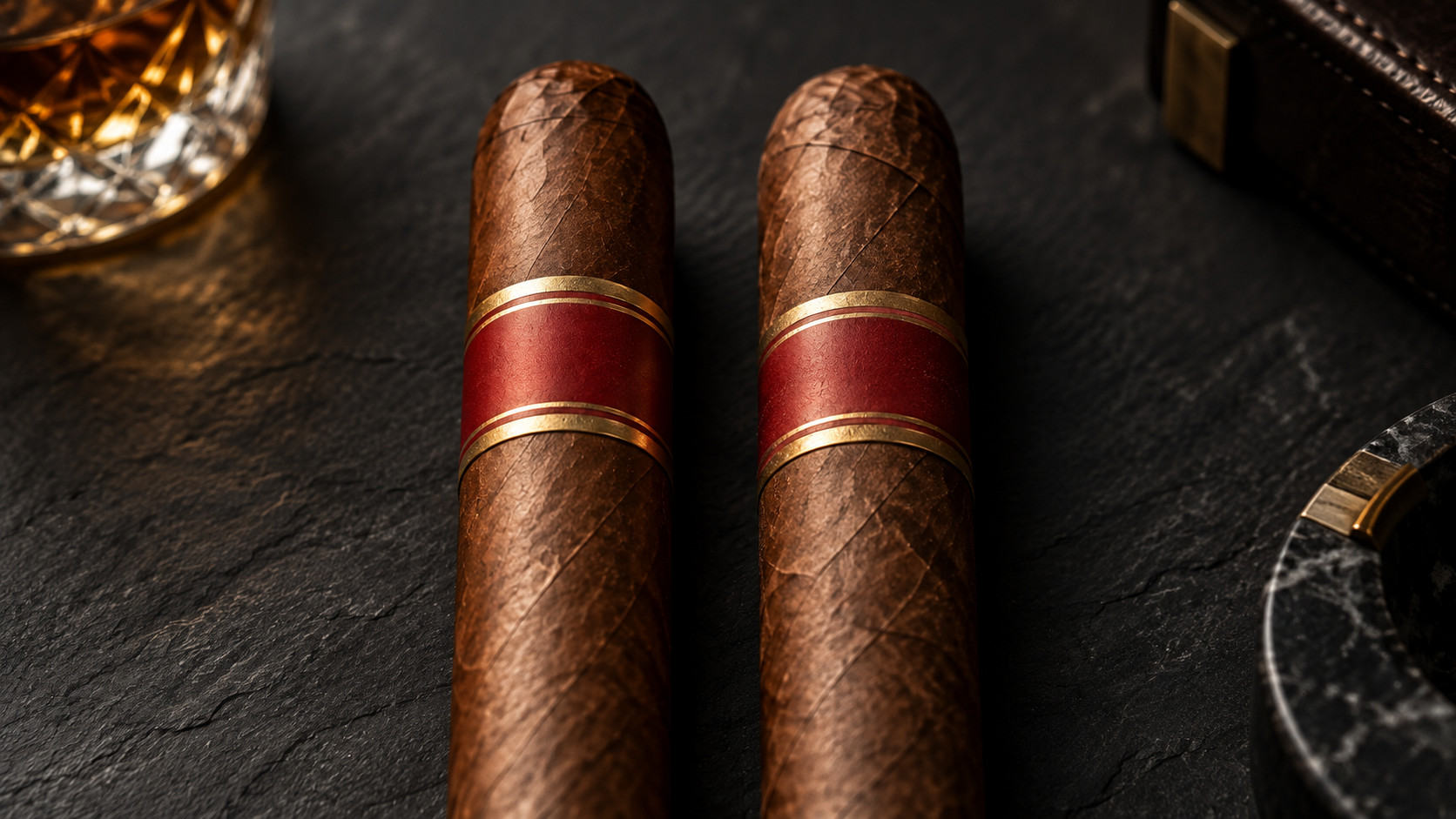
| Band printing | Crisp edges, even embossing, consistent color across every band in the box | Fuzzy fine detail, slight color drift between bands, flat or overdone foil |
| Band placement | Aligned to the same height and rotation across the row | Heights and seams visibly wander from cigar to cigar |
| Box construction | Clean joinery, flush lid, correct timber and interior finish | Rough edges, gaps at the corners, lid that sits proud, wrong smell inside |
| Seals and stamps | Squarely placed, correct position on the box, undamaged | Crooked, bubbled, doubled, or positioned where the marque does not use them |
| Cigars in the box | Uniform color, matched cap work, consistent fill when gently pressed | Mixed shades, mismatched caps, soft spots next to hard spots |
| Draw and burn | Consistent behavior across the box | One cigar plugs, the next runs, no two behave alike |
| Paperwork | Verifiable receipt from a traceable business | Cash only, no receipt, no return path |
Read that table top to bottom and notice how the reliable signals sit in the first two rows, before you ever touch the product. That ordering is deliberate.
Direct answer: Four channels account for most of it: street and hotel approaches in tourist cities, unverified social media sellers, marketplace and auction listings with no provenance, and informal resale between individuals where a box has already changed hands several times.
What links them is not the internet or the street. It is the absence of anyone who has something to lose. An authorized retailer risks an account, a reputation and a business if it sells fakes. A stranger with a duffel bag risks a walk to the next corner. Every one of these channels works by removing the party who would otherwise carry that risk, and the discount you are offered is simply the value of the protection you gave up.
Travel deserves its own warning, because it produces the most predictable version of the mistake. A visitor in an unfamiliar city, aware that a famous marque is difficult to obtain at home, is approached by someone friendly and knowledgeable who explains that a factory worker took these home. The story is designed to explain the price and the lack of a receipt at the same time. It is the oldest script in the trade and it still works, which is precisely why it is still in use. If the culture and history behind those famous names is what draws you, our piece on Cuban cigar culture is a better place to spend the money’s worth of curiosity.
Six habits cover nearly every realistic case.
One more habit matters after the purchase. Fakes are frequently stored badly before they reach you, so a box that arrives dry, or damp, or smelling of ammonia, is telling you something about its history. Our guide to how to store cigars covers what correct condition should look and feel like, which doubles as a baseline for judging anything you receive.
A counterfeiter can reproduce a band, a box, a seal and a code. What cannot be reproduced is a short chain of custody, because that is not an object. It is a fact about who touched the cigar and when.
Founder and master roller Raul Triana learned the craft in Cabaiguan, Cuba, and has more than 35 years of experience at the bench. He rolls by hand himself in Boca Raton, Florida, which means the distance between the person who made your cigar and the person who sold it to you is zero. There is no distributor, no gray market, no room in the middle where a band could be swapped. You can read the whole story on our about us page, or simply watch it happen.
Every order from the RTS Cigars shop ships free, and the Super Premium Collection arrives hand packed in a handcrafted cedar box. For those who would rather see the work than take anyone’s word for it, a live rolling event across Miami, Fort Lauderdale, West Palm Beach, Orlando or the Florida Keys is the most complete answer to the counterfeit question that exists: the cigar is rolled in front of you, and authenticity stops being a claim you have to evaluate.
For adults 21+ only. RTS Cigars products are intended for adults of legal purchasing age.
They are cheap or unbranded cigars fitted with copied bands, boxes, seals, stamps and codes so they can be sold as a famous marque. The tobacco is usually low grade and unrelated to the brand on the band. The fraud lives almost entirely in the packaging, which is inexpensive to print at convincing quality.
Start with the channel rather than the cigar. An authorized retailer or the maker directly is the strongest protection available. After that, examine the row as a whole: counterfeits fail on consistency, so look for band heights and rotations that wander, color drift between bands, rough box joinery, crooked seals and cigars of mixed shade or fill within one box.
They combine name recognition among people who do not smoke cigars with a long standing perception of scarcity. That second part is what makes a heavily discounted offer from a stranger sound plausible instead of absurd. Spain is a frequent hub in European cases because it is the largest European market for official Cuban exports.
They are produced with no quality control, no traceable sourcing and frequently poor storage, so buyers commonly encounter mold, beetle damage and wildly inconsistent construction. Beyond that, we do not make health or safety claims about any tobacco product. Every cigar, authentic or not, is intended only for adults of legal purchasing age.
Trade press reported that in July 2026 investigators dismantled a network operating from a residence in Mislata near Valencia, seizing 33,840 counterfeit Cuban cigars and 637,646 fake bands from brands including Cohiba and Punch, along with assembly and packaging equipment. Three people were arrested and four others were placed under investigation.
Not always, since authorized retailers do run legitimate promotions and clear discontinued stock. The warning sign is a discount that has no explanation attached to it, especially when it arrives with urgency, a cash only arrangement, or a story about where the box supposedly came from.
Stop and document. Photograph the box, the bands, the seals and the listing or receipt, then contact the seller or the platform to request a refund. Where a marketplace is involved, report the listing so the seller can be reviewed. If the purchase was cash from an untraceable source, recovery is generally not possible, which is the practical reason the channel matters more than the inspection.