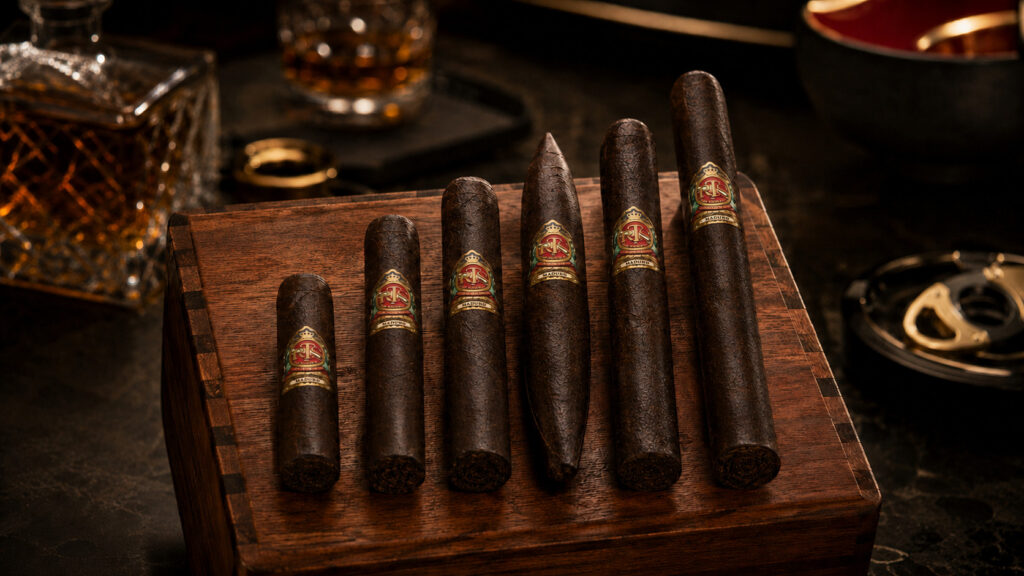
Walk into any lounge and the first thing you notice is variety. Short and thick, long and slender, tapered to a point, pressed into a soft rectangle. Cigar sizes and shapes are not decoration, they are decisions, and each one changes how a cigar draws, how long it lasts, and how the blend reveals itself from the first light to the final inch. This guide explains what the traditional names mean, how length and ring gauge shape the experience, and how to pick the format that fits the moment in front of you.
Quick Answer: Cigar sizes and shapes are described by a vitola, the traditional name for a given format, which combines a length in inches and a ring gauge measured in sixty-fourths of an inch. Straight-sided cigars are called parejos and include the robusto, corona, toro and churchill. Tapered or irregular cigars are called figurados and include the torpedo, belicoso, pyramid and perfecto. Size changes the smoking time and the balance of wrapper to filler, which is why the same blend can taste noticeably different in two formats.
In the cigar world, a format has a name, and that name is called a vitola. A vitola is shorthand for a specific combination of length and thickness, and often for a particular silhouette as well. When a roller says robusto, everyone at the bench knows roughly what is being asked for. When a catalogue lists a torpedo, the reader knows the head will come to a taper. The vocabulary exists because the format genuinely matters, not because the industry enjoys naming things.
Formats divide into two broad families. Parejos are the straight-sided cigars, cylinders with a rounded cap at the head and an open foot at the other end. Most cigars you encounter are parejos, and the familiar names of robusto, corona, toro and churchill all belong to this family. Figurados are the shaped cigars, the ones that taper, bulge, or close at both ends. They are harder to roll and, for that reason, they have long been a way for a factory to show what its hands can do.
The reason any of this matters is that a cigar is not a uniform substance. It is a bundle of different leaves in a specific arrangement, and the shape of the bundle determines how much of each leaf you are drawing through at any given moment. Change the shape and you change the ratio. That is why the same blend, rolled in two formats, can feel like two related but distinct experiences, and why experienced smokers often have a favorite size before they have a favorite brand.

Two numbers do most of the work. The first is straightforward: length, given in inches, tells you how far the cigar runs from foot to head. The second takes a moment to get used to. Ring gauge counts in sixty-fourths of an inch, an old convention that has stuck around because it gives useful precision without decimals. A 50 ring gauge cigar is fifty sixty-fourths across. A 60 ring gauge cigar is noticeably fatter, and a 38 is slim enough to sit lightly between two fingers.
Once the convention clicks, the numbers become genuinely informative. Length is a rough proxy for smoking time, since a longer cigar simply has more distance to burn. Ring gauge is a proxy for how much filler tobacco sits inside relative to the wrapper leaf surrounding it. A thin cigar has a high proportion of wrapper to filler. A thick cigar has a low one. Since the wrapper is the most carefully selected leaf on the cigar and carries a great deal of its character, that ratio has real consequences for what you taste.
It is worth noting that these measurements describe the cigar, not its quality. A 6 by 60 is not automatically stronger than a 4 by 42, and a long cigar is not automatically better than a short one. The numbers tell you about proportions and duration. Everything else, the blend, the leaf, the skill of the roller, is a separate question, and the interplay between blend and format is where the craft really lives.
Start with the robusto, because it has become the default for a reason. Short enough to finish without committing an entire evening, thick enough to burn cool and give the blend room to develop, it is the format many blenders reach for when they want to show a cigar at its most balanced. If you are learning a new blend and want a fair impression of it, the robusto is a sensible first stop.
The corona is the older classic and, to many traditionalists, the purest expression of a blend. It is slimmer than a robusto, which raises the proportion of wrapper leaf in every draw and tends to bring the wrapper’s character forward. Coronas are quicker than their length suggests and reward attention, since a thinner cigar burns a little warmer and asks you to pace yourself. Smokers who love a Connecticut or a bright Habano wrapper often gravitate here.
The toro stretches the robusto out. Same generous thickness, more length, which usually means a longer and more gradual evolution from the opening third to the final one. If a blend builds slowly, the toro gives it the runway. The churchill goes further still, long and moderately thick, and it belongs to unhurried occasions: a long conversation, a round of golf, an evening with nowhere to be. The panetela and the lancero sit at the slender end of the family, long and thin, and they are the connoisseur’s formats, prized precisely because that high wrapper ratio makes every nuance audible.
Figurados are where rolling becomes visibly virtuosic. Any shape that departs from the simple cylinder demands more from the torcedor, because the filler has to be bunched so that it fills a changing diameter without ever choking the draw. A poorly made figurado is immediately obvious. A well made one is a small piece of engineering.
The torpedo tapers to a pointed head, which concentrates the smoke as it reaches the palate and gives the smoker a degree of control: cut a little off the tip for a tight, focused draw, or cut deeper for a more open one. The belicoso is its shorter cousin, with a rounder and less severe taper. The pyramid takes the idea to its logical conclusion, widening steadily from a pointed head to a broad foot, so the cigar effectively changes ring gauge as it burns and the balance of leaves shifts under you as you go.
The perfecto is the most theatrical of all, closed at both ends and bulging in the middle. It starts narrow, opens up, and narrows again, which means the smoking experience is genuinely three-act. Recent trade show coverage has shown a strong appetite for these shapes, with tapered and rounded perfectos appearing among the more talked-about limited formats of 2026, a sign that shaped cigars remain a way for makers to demonstrate craft. The diadema, longer and more dramatic still, is rarer, and the culebra, three thin cigars braided together, is rarer yet and mostly a curiosity with a good story attached.
Direct answer: Length mainly determines how long the cigar lasts, while ring gauge determines the ratio of filler to wrapper, so thinner cigars tend to emphasize the wrapper’s character and burn a little warmer, and thicker cigars burn cooler and give the filler blend more room to express itself.
Consider what is physically happening. Smoke travels the length of the cigar before it reaches you, and along the way it passes through the burning cone and the tobacco just behind it. In a slim cigar, that column of tobacco is narrow, so the burning cone is small and the wrapper leaf makes up a larger share of what is combusting at any moment. In a thick cigar, the cone is broad, the interior filler dominates by volume, and the wrapper is a proportionally thinner skin around a larger core.
This is why format is a blending decision, not an afterthought. A blender who has built a filler recipe with a lot of complexity may choose a bigger ring gauge so that recipe has room to speak. A blender who has sourced an extraordinary wrapper may choose a slimmer format so that leaf is never drowned out. Neither choice is superior. They are answers to different questions, and understanding the question makes you a better reader of the cigar in your hand. If you want to go deeper on how wrapper leaf drives flavor, our guide to cigar wrapper types covers Connecticut, Habano and Maduro in detail.
There is a practical dimension too. Bigger ring gauges generally burn cooler, which is forgiving if you are talking and letting the cigar rest between draws. Slimmer cigars are less forgiving and ask for a steady, unhurried rhythm, since drawing too often will heat them up quickly. Length works on your schedule rather than your palate: a short cigar respects a short window, and a long one deserves the time it asks for.
The table below sets the common formats next to one another. The dimensions are typical rather than absolute, since houses vary, but they give a reliable sense of the landscape.
| Vitola | Typical Size | Family | Approx. Smoking Time | Character Tendency | Good For |
|---|---|---|---|---|---|
| Petit Corona | 4.5 x 42 | Parejo | 30 to 40 minutes | Wrapper forward, brisk | A short break |
| Robusto | 5 x 50 | Parejo | 45 to 60 minutes | Balanced, blend showcase | Learning a new blend |
| Corona | 5.5 x 42 | Parejo | 45 to 60 minutes | Elegant, wrapper led | Traditionalists |
| Toro | 6 x 50 | Parejo | 60 to 75 minutes | Gradual, evolving | An unhurried hour |
| Churchill | 7 x 47 | Parejo | 75 to 90 minutes | Long, developing arc | Golf, long conversations |
| Lancero | 7.5 x 38 | Parejo | 60 to 75 minutes | Highest wrapper ratio, nuanced | Connoisseurs |
| Torpedo | 6 x 52 tapered | Figurado | 60 to 80 minutes | Focused, adjustable draw | Smokers who like control |
| Perfecto | Varies, closed ends | Figurado | Varies | Shifts as ring gauge changes | A cigar with a story |
Read the table as a map rather than a ranking. Nothing in it says that a churchill is a finer cigar than a petit corona, only that they suit different windows of time and different appetites for detail. The most useful column is often the last one, because it asks the question that actually decides the evening: what is the occasion, and how much time does it have?
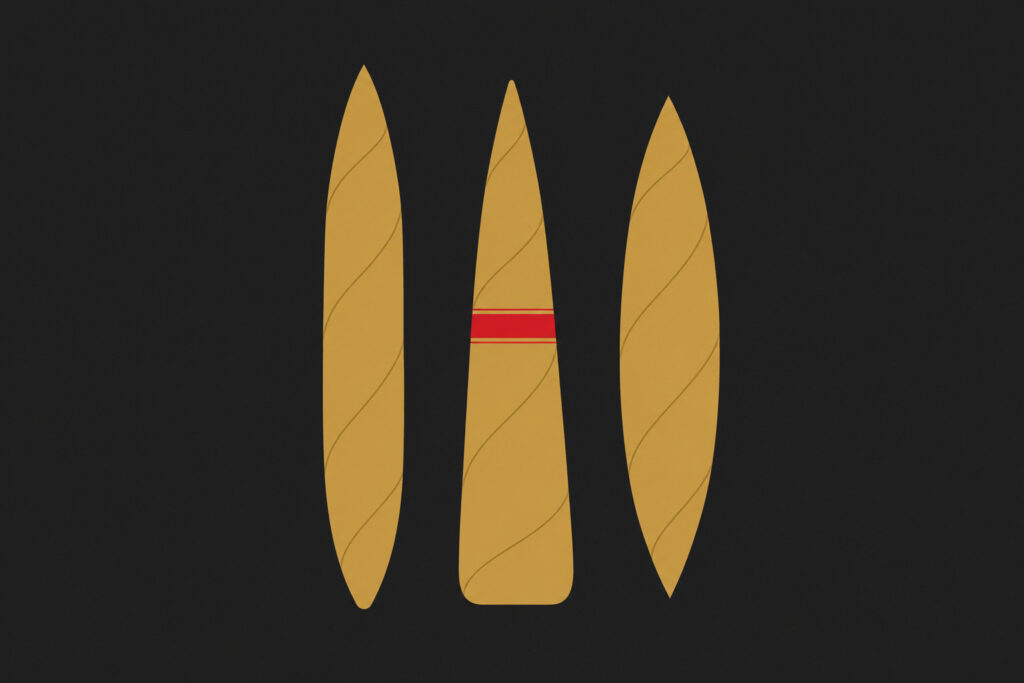
Start with the clock. This is the single most reliable filter, and it prevents the most common disappointment, which is lighting a cigar you cannot finish. Thirty minutes before dinner is petit corona territory. An hour on the patio suits a robusto or a corona. A long golf round or a slow evening with friends is where the toro and the churchill earn their keep. A cigar you have to abandon halfway is a cigar you did not really enjoy.
Then think about what you want from the leaf. If you are trying a house for the first time, a robusto gives you the fairest and most balanced picture of what the blender intended. If you already know a blend and want to hear its wrapper more clearly, step into a slimmer format and pay attention to what comes forward. If you want the filler to have room to unfold, go thicker. Treat format as an instrument you can tune rather than a fixed property of the cigar.
Finally, consider the setting. Outdoors, in wind, a thicker ring gauge is simply more stable and less prone to burn trouble. At a table, in still air, a slim cigar behaves beautifully. At an event where guests are moving, talking, and setting cigars down between draws, larger formats are more forgiving of the neglect. This is one of the reasons an experienced roller working an event will ask what the day looks like before recommending a size, and it is worth asking yourself the same question. For events specifically, our guide on how to choose the right cigar rolling package walks through the practical side.
The churchill takes its name from Winston Churchill, whose fondness for large cigars was famous enough that the format was named in his honor, a rare case of a person becoming a unit of measurement. The lancero, meanwhile, owes its enduring prestige partly to scarcity: it is difficult to roll well, it uses a great deal of wrapper leaf relative to filler, and a factory that offers one is quietly advertising the skill of its bench.
The culebra is the strangest survivor in the catalogue. Three slender cigars twisted together and sold as a unit, it is said to have originated as a way of controlling how many cigars rollers took home, since a braided trio was obvious and could not be quietly slipped into a pocket. Whether the story is entirely true or partly folklore, the shape has outlived its supposed purpose and now exists mostly to be photographed and puzzled over.
Then there is the long, slow drift in taste. For much of the twentieth century, 42 to 46 ring gauge was normal and anything above 50 was unusual. In the last two decades the market has moved steadily thicker, with 52, 54 and even 60 becoming ordinary. Yet the slim formats have never disappeared, and the trade press still greets a new lancero with the enthusiasm reserved for a difficult thing done well. Publications such as Cigar Aficionado and halfwheel track these format trends closely, and the coverage of the 2026 trade show season showed the full spread, from petite tins to broad perfectos, all in the same season.
At RTS Cigars, format is a conversation, not a catalogue entry. Founder and master roller Raul Triana, from Cabaiguan, Cuba, brings more than 35 years of experience to the bench, and every cigar is hand-rolled in Boca Raton, Florida. When you roll by hand, the shape is a choice made leaf by leaf, and the roller’s judgment about bunching and tension is what allows a slim lancero or a tapered figurado to draw as cleanly as a robusto.
That craft is easiest to appreciate when you watch it happen. At our live rolling events across Miami, Fort Lauderdale, West Palm Beach, Orlando and the Florida Keys, guests see a master roller shape cigars in real time, and the difference between a parejo and a figurado stops being an abstraction. Our finest tobacco appears in the Super Premium Collection, hand packed in a handcrafted cedar box.
If you are ready to find the format that suits your evening, browse the RTS Cigars shop, where every order ships free, or get in touch to talk through an event. We are always happy to help an adult smoker find the size that fits the occasion rather than the other way around.
For adults 21+ only. RTS Cigars products are intended for adults of legal purchasing age.
Ring gauge is the diameter of a cigar expressed in sixty-fourths of an inch. A 50 ring gauge cigar measures fifty sixty-fourths of an inch across, just under eight tenths of an inch. Larger ring gauges hold more filler tobacco relative to the wrapper leaf.
A parejo is a straight-sided cigar with a rounded cap, such as a robusto, corona, toro or churchill. A figurado is a shaped cigar that tapers or bulges, such as a torpedo, belicoso, pyramid or perfecto. Figurados are more difficult to roll by hand.
Size changes the balance rather than the blend. A slimmer cigar has a higher proportion of wrapper leaf, which tends to bring the wrapper’s character forward, while a thicker cigar burns cooler and gives the filler more room to express itself. The same blend can feel noticeably different in two formats.
A robusto, roughly 5 by 50, is a common starting point because it is balanced, burns cool, and finishes in about an hour. It gives a fair impression of what a blender intended without asking for a long time commitment.
Roughly speaking, a petit corona takes 30 to 40 minutes, a robusto or corona takes 45 to 60 minutes, a toro takes 60 to 75 minutes, and a churchill can take 75 to 90 minutes. Pace and personal rhythm affect the total.