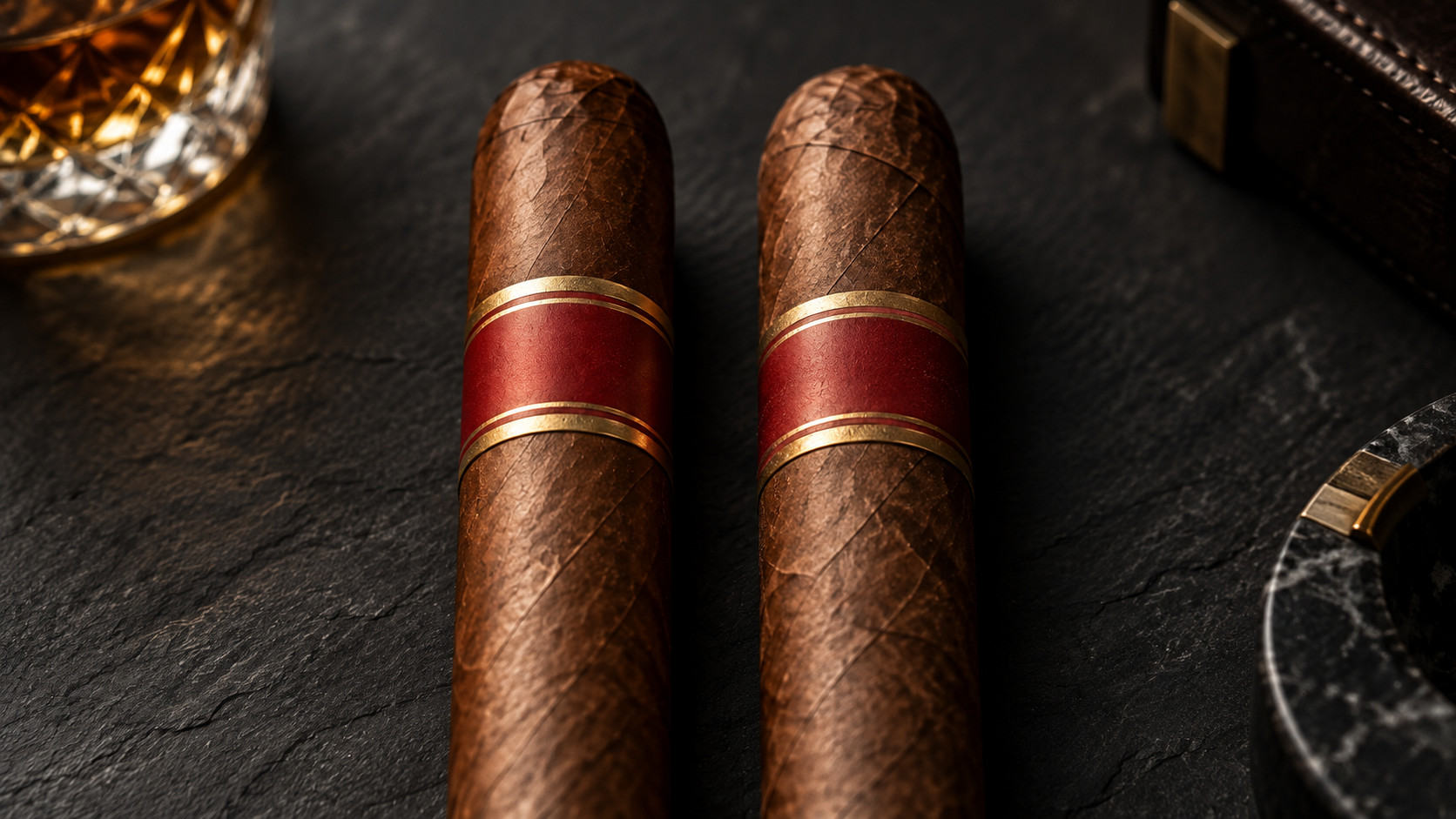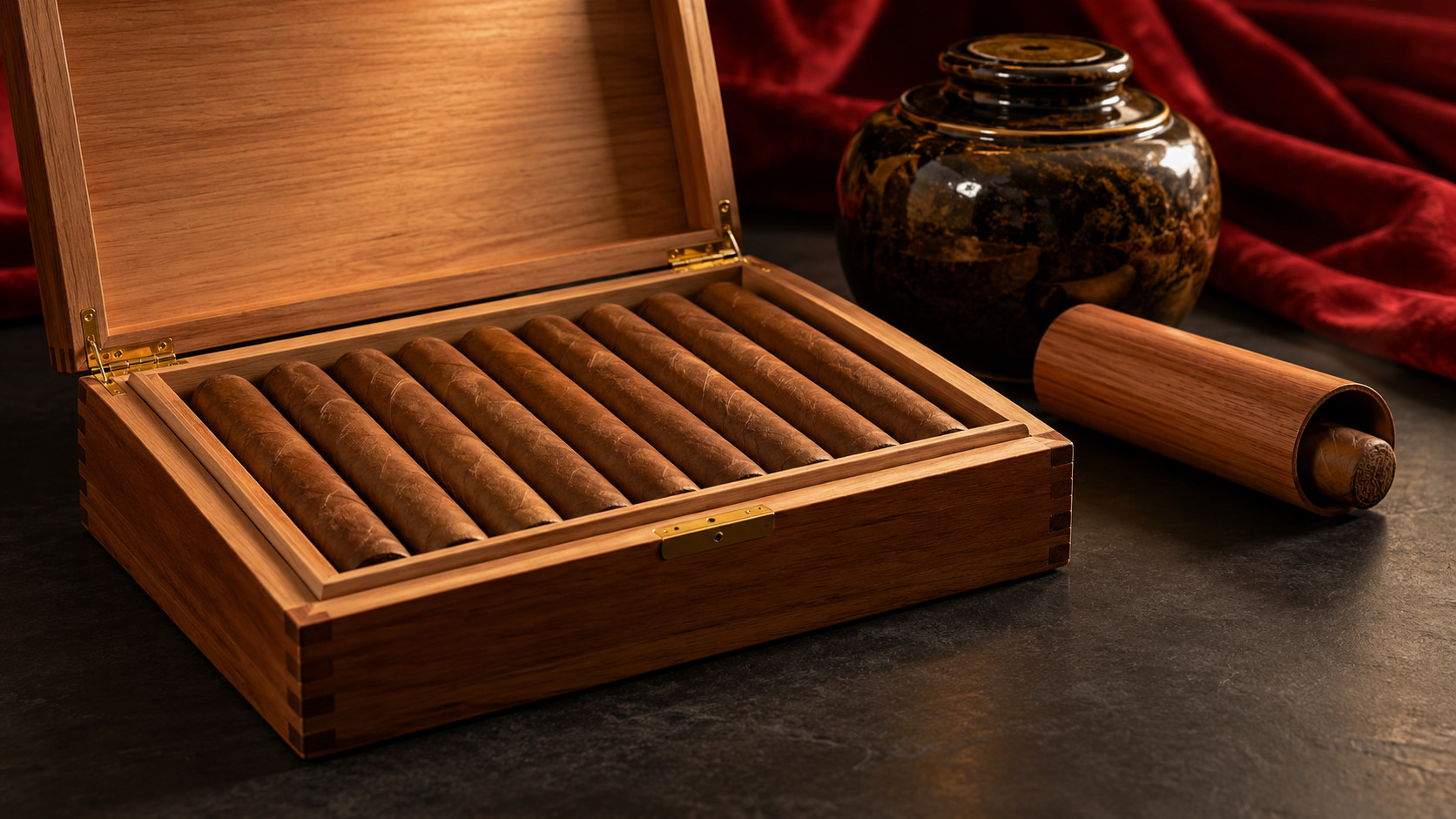

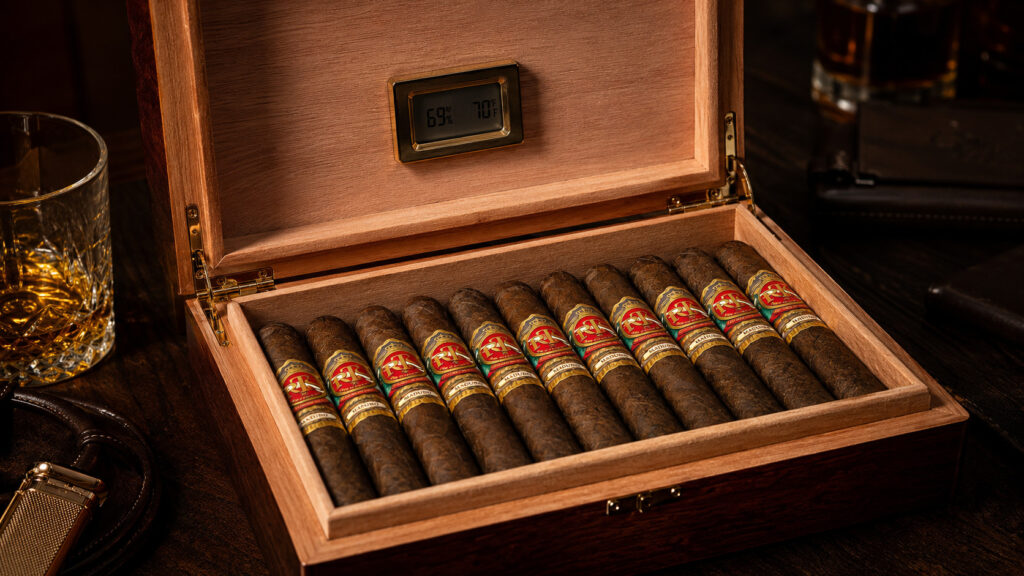
A premium cigar is a living, agricultural thing. It was grown, fermented, aged, and rolled by hand, and it arrives in your care still responding to the air around it. Learning how to store cigars is really learning to give that tobacco a stable home, one where the moisture it was built with stays where it belongs. Get it right and a cigar rewards you with an even burn and a clean draw months or years later. Get it wrong and even the finest roll will disappoint. This guide covers humidity, humidors, seasoning, short-term options, and the mistakes worth avoiding.
Quick Answer: Store cigars in a sealed, humidified container held at roughly 65 to 70 percent relative humidity and around 65 to 70 degrees Fahrenheit. A seasoned Spanish cedar humidor is the traditional choice, though a well sealed airtight container with a two-way humidity pack works well for smaller collections. Keep the container out of direct sunlight, away from heat, and check the humidity with a calibrated hygrometer rather than trusting the reading it came with.
Tobacco is hygroscopic, which is a technical way of saying it exchanges moisture with the air until the two reach a balance. Leave a cigar on a desk in a dry room and it will surrender moisture to that room until it is brittle. Leave it in a damp basement and it will draw moisture in until it is spongy. Neither state is recoverable in any satisfying way, because the damage is structural: the leaves shrink, split, or swell, and the careful architecture the roller built comes apart.
The practical consequences are immediate. A cigar that has dried out burns fast and hot, the wrapper cracks, and the draw runs loose. A cigar that has taken on too much moisture is difficult to draw, refuses to stay lit, and burns unevenly down one side. In both cases the blend the maker spent months balancing simply cannot show itself, because combustion is uneven and the smoke is either scorching or stalling. Storage is not a garnish on the hobby, it is the condition that lets everything else work.
There is a second, more appealing reason to take storage seriously. Well kept tobacco continues to settle over time. The leaves in a blend, which were pressed together only recently in the roller’s hands, gradually come into agreement with one another, and many enthusiasts find that a cigar rested for several months in stable conditions feels more integrated than the same cigar smoked the week it was rolled. Good storage is not just preservation, it is the environment in which patience pays.
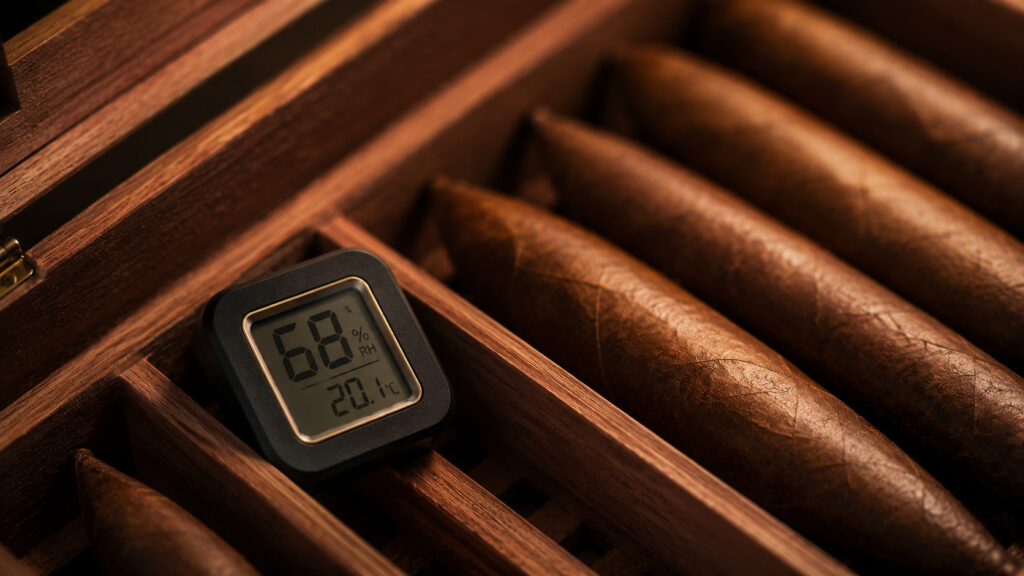
Direct answer: Aim for approximately 65 to 70 percent relative humidity and roughly 65 to 70 degrees Fahrenheit, and treat stability as more important than hitting an exact number, since swings do more harm than a steady reading a few points off target.
The old shorthand is the 70/70 rule, meaning seventy percent humidity and seventy degrees. It is a reasonable starting point and it is easy to remember, but most experienced collectors settle a little lower on the humidity side, somewhere in the mid sixties. Slightly drier storage tends to produce a firmer cigar that lights readily and burns evenly, and it gives you a margin of safety, since the consequences of running a few points too damp are worse than running a few points too dry.
Temperature matters for a different reason. Warmth accelerates everything, including the life cycle of the tobacco beetle, whose eggs can lie dormant in leaf and hatch when conditions get hot. Keeping storage below the low seventies is the standard precaution, and it costs nothing but a sensible choice of shelf. A closet on an interior wall is almost always better than a windowsill, a garage, or a spot above a radiator.
Above all, chase stability. A humidor that sits patiently at 64 percent all year is doing a better job than one that swings between 58 and 74 as the seasons turn, even though the second one hits the textbook number twice a year. Wood, leaf, and glue all expand and contract with moisture, and repeated cycling is what cracks wrappers and loosens caps. Set your conditions, verify them, and then leave them alone.
The lining is the part people underestimate. Spanish cedar, which is not a true cedar at all but a tropical hardwood, has been the standard for generations because it holds moisture well, releases it slowly, imparts an aroma that complements rather than competes with tobacco, and is unappealing to the beetles that threaten a collection. A box lined with the wrong wood, or with a heavy varnish that seals the wood off, cannot buffer humidity the way a cedar-lined box does.
Size is the next decision, and the instinct to buy big is usually wrong. A humidor holds humidity most easily when it is reasonably full, because the cigars themselves act as a moisture reservoir. A twenty-five count box that is nearly full will hold a steadier reading than a hundred count box holding a dozen cigars in a large volume of air. Buy for the collection you actually have, and upgrade when you outgrow it. The accessory market has responded to serious collectors with cabinet humidors for the home, alongside travel cases and desktop options, so there is a sensible answer at almost every scale.
Finally, the two devices inside. Humidification can be as simple as a two-way pack, which absorbs and releases moisture to hold a set point and requires almost no attention, or as involved as a crystal gel or electronic system for larger volumes. Two-way packs have made good storage genuinely easy, and there is no snobbery worth entertaining here. The hygrometer, meanwhile, should be treated with suspicion until proven trustworthy: many that ship with humidors are inaccurate out of the box, and a digital unit you have calibrated yourself is worth far more than a decorative analog dial.
A new humidor arrives thirsty. The cedar lining is dry from the workshop and will pull moisture out of the air, and out of your cigars, until it is satisfied. Seasoning is the process of letting the wood drink first so it stops stealing from the tobacco later, and skipping it is the single most common way people ruin a first box of cigars.
The gentle method is the reliable one. Place a container of distilled water inside the closed humidor, or use a seasoning pack designed for the purpose, and leave it shut for several days. The cedar will slowly absorb moisture from the humid air, which is exactly the behavior you want, without the risk of warping. Check after two or three days, top up if needed, and continue until the interior holds a steady reading in the target range on its own. Depending on the size of the box and how dry it started, this can take anywhere from a few days to a couple of weeks.
Resist two temptations. The first is wiping the interior down with a soaked sponge, which forces water into the wood too fast and can swell or warp the lining. The second is using tap water, which carries minerals and can encourage mold. Distilled water only, patience always. Once the humidor holds its reading unaided for a day or two with nothing inside but the humidification device, it is seasoned and ready, and you can load it and let the cigars settle for a week before you smoke the first one.
Not everyone needs a furniture-grade box, and nobody should let the absence of one become an excuse for poor storage. The essential requirements are an airtight seal, a stable humidity source, and protection from heat and light. Any container that satisfies those three can keep cigars in excellent shape.
The most popular improvised solution is a sealed food-storage container or a hard-sided case with a good gasket, fitted with a two-way humidity pack and, ideally, a small strip of Spanish cedar to lend the interior some character and buffering. This setup, sometimes called a tupperdor, is unglamorous and remarkably effective, and many collectors use one alongside a proper humidor for overflow. A resealable bag with a humidity pack works too for short periods and for travel, though it offers less protection against being crushed.
For travel specifically, a purpose-built case matters more than you would expect, because physical damage and temperature swings do more harm on the road than gradual humidity drift ever does at home. A hard case with a small humidity pack will carry cigars safely through a weekend or a golf trip. The accessory releases coming out of the 2026 trade show season leaned heavily into exactly this, with leather travel cases and humidified packs designed to keep a handful of cigars in good condition away from the main collection.
Different situations call for different solutions. The table below compares the realistic options.
| Option | Typical Capacity | Humidity Control | Best For | Effort | Watch Out For |
|---|---|---|---|---|---|
| Desktop humidor | 25 to 100 cigars | Cedar lining plus pack or gel | Everyday home collection | Low once seasoned | Buying too large for your stock |
| Cabinet humidor | Several hundred | Larger active system | Serious collectors, lounges | Moderate | Cost and floor space |
| Airtight container with pack | 10 to 50 cigars | Two-way humidity pack | Starting out or overflow | Very low | No cedar aroma unless you add a strip |
| Hard travel case | 2 to 10 cigars | Small humidity pack | Golf, trips, events | Very low | Not for long-term aging |
| Resealable bag with pack | A few cigars | Two-way humidity pack | A day or a weekend | None | Crushing, no protection from heat |
| Loose on a shelf | Any | None | Nothing at all | None | Cigars dry out within days |
The pattern in that table is worth naming. What separates the good options from the bad one is not price or prestige, it is whether the container can hold a seal and hold a humidity level. A twenty dollar airtight box with a two-way pack outperforms a beautiful antique humidor with a warped lid every single time, and it is a far better place to keep a cigar than a drawer.
Skipping seasoning tops the list, and it is worth repeating because the damage is invisible until it is done. A new humidor loaded straight from the shop will quietly pull moisture out of your cigars for weeks while the hygrometer tells you a comforting story, and by the time the wrappers start to crack the cause is long past.
Trusting the included hygrometer is the second mistake. Analog dials in particular are often several points out, and a hygrometer that reads high while the box runs dry is worse than no hygrometer at all, because it removes the suspicion that might have saved the collection. Calibrate with a salt test or buy a digital unit from a maker that specifies its accuracy, and check it once a year.
Two more are worth naming. Overfilling a humidor restricts airflow and creates pockets that sit damper than the rest of the box, which is where mold begins. And storing cigars somewhere convenient rather than somewhere stable, on top of a refrigerator, near a window, in a car, subjects them to exactly the temperature and humidity cycling that does the most harm. The best spot in most homes is a closet on an interior wall, which is boring, and boring is the point.
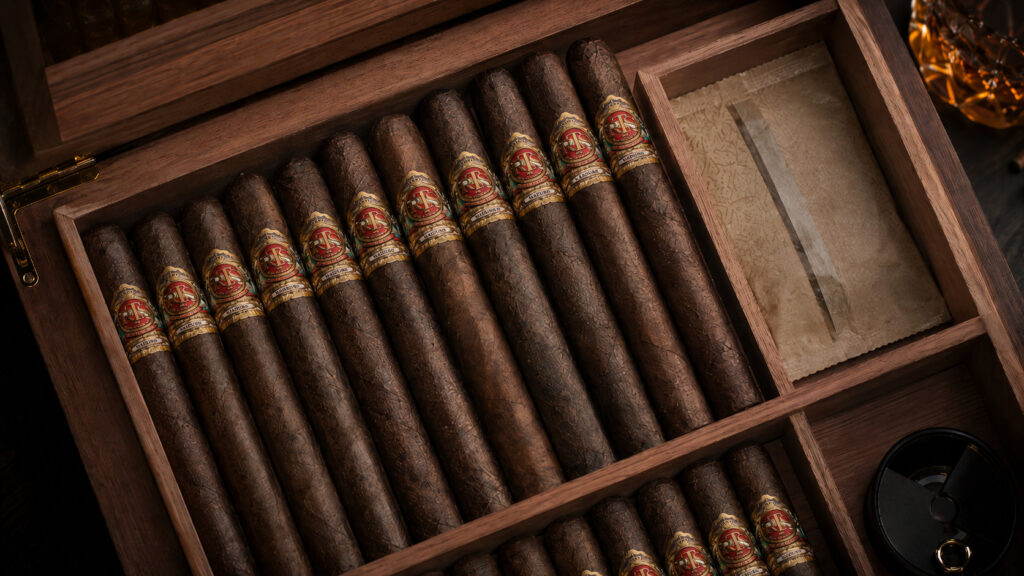
Spanish cedar, the wood inside virtually every good humidor, is not related to the cedars of the Mediterranean or the Pacific Northwest at all. It belongs to the mahogany family, and the name is a historical accident born from a passing resemblance in aroma. Its dominance in the cigar world is entirely functional: it buffers humidity, it is unattractive to insects, and its scent has become so bound up with the experience of opening a box that most enthusiasts would notice its absence immediately.
The relationship between cedar and cigar goes further than the humidor. Cigars are often shipped and stored on thin cedar sheets, and boxes themselves are frequently built from the same wood, so the tobacco has usually been in conversation with cedar since long before it reached you. A handcrafted cedar box is not merely presentation, it is a functioning piece of the storage system.
As for aging, there is real romance and some real physics. Under stable conditions, the components of a blend continue to settle and marry over months and years, and long-aged tobacco is prized enough that trade publications regularly note when a maker has held leaf back for five years or more before rolling. What aging cannot do is rescue a cigar that has been stored badly, and it cannot improve a blend that was never good. Time is a multiplier, not a correction, and stable storage is what lets it multiply in the right direction. Publications such as Cigar Journal and halfwheel cover this ground regularly if you want to read further.
Everything above is why we take packing as seriously as rolling. Every RTS cigar is hand-rolled in Boca Raton, Florida, by founder and master roller Raul Triana of Cabaiguan, Cuba, who brings more than 35 years of experience to the bench. A cigar built with that much care deserves to reach you in the condition it left in, which is why our Super Premium Collection is hand packed in a handcrafted cedar box, a presentation that is also a working part of the storage.
Once your cigars arrive, give them a week to settle in your humidor before you light the first one. Travel is a small shock even when everything is done right, and a short rest at a steady humidity lets the leaves come back into balance. If you are new to the hobby and do not yet have a humidor, start with an airtight container and a two-way pack, and upgrade when your collection asks for it.
Browse the RTS Cigars shop, where every order ships free, or read a little about our story and the roller behind the bench. Planning something bigger? Our live rolling events across South Florida bring the craft to your guests, and you can contact us to talk it through.
For adults 21+ only. RTS Cigars products are intended for adults of legal purchasing age.
Aim for roughly 65 to 70 percent relative humidity at around 65 to 70 degrees Fahrenheit. Many collectors prefer the mid sixties, since slightly drier storage lights and burns more reliably and gives a margin of safety against mold.
Not necessarily. What you need is an airtight container, a stable humidity source such as a two-way humidity pack, and protection from heat and light. A sealed container with a humidity pack works very well, though a Spanish cedar humidor adds buffering and aroma.
Place distilled water in a shallow container inside the closed humidor, or use a purpose-made seasoning pack, and leave it sealed for several days until the interior holds a steady humidity in the target range. Never wipe the lining with a soaked sponge and never use tap water.
Under stable conditions, cigars can be kept for years, and many enthusiasts find that a blend settles and integrates over time. Stability matters far more than duration, since repeated humidity swings damage cigars regardless of how long they have been stored.
Spanish cedar, which is actually part of the mahogany family, holds and releases moisture slowly, which helps buffer humidity swings. It also carries an aroma that complements tobacco and is unattractive to the insects that can threaten a collection.